Here's the third letter of the tree alphabet. Alder is the tree of time - some of its branches carry the past, the present and the future - last year's cones (the letter L), this year's cones (the letter D) and next year's catkins (the letter E). The Ogham character is above it.
Friday, 3 January 2014
Thursday, 2 January 2014
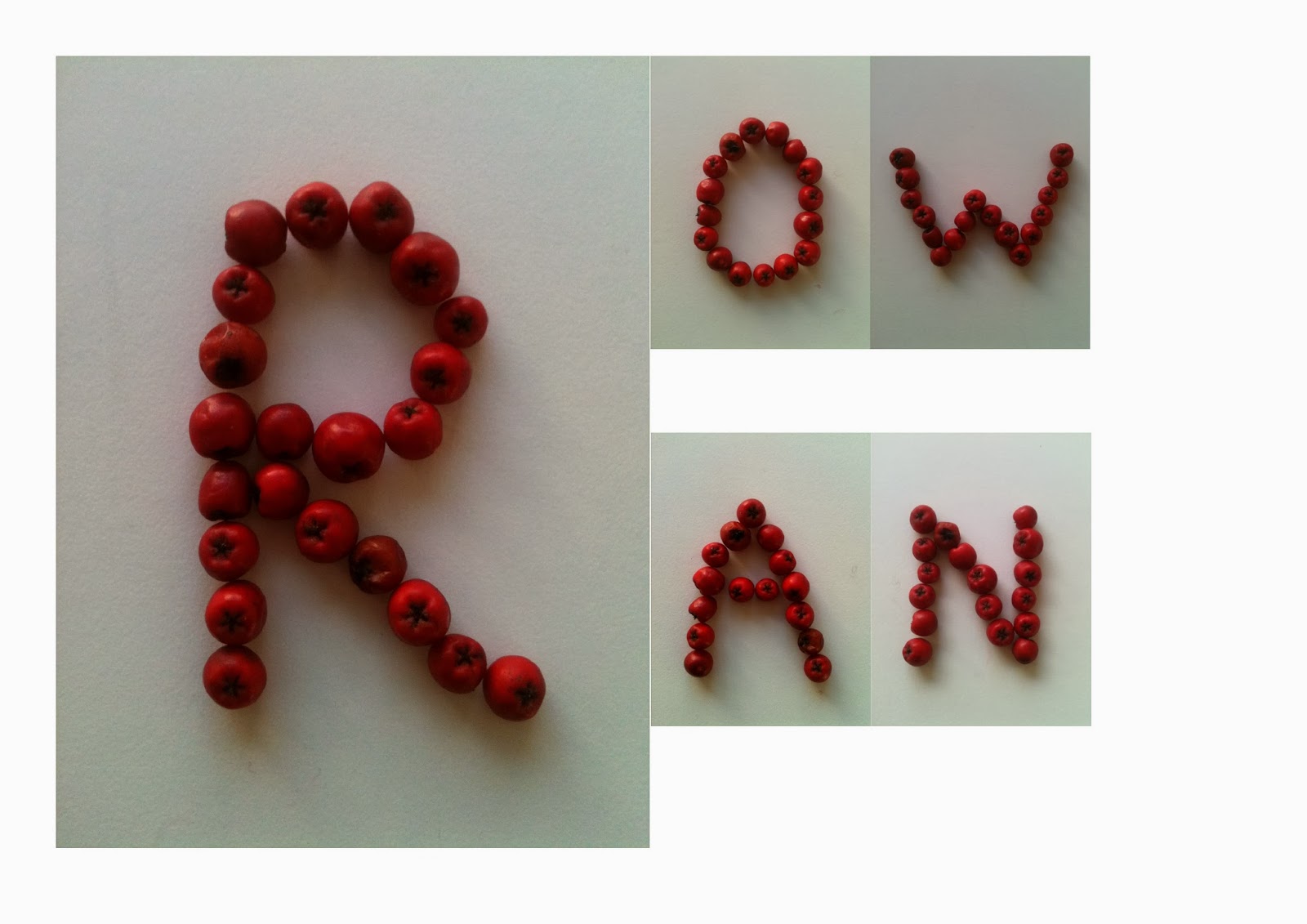
Rowan
Here's the second alphabet photopoem, the letters arranged symbolically into the form of the second letter of the Ogham alphabet - a vertical line with two horizontal 'twigs'.
Wednesday, 1 January 2014
Birch
Happy New Year! I have resolved this year to get more of my poetry and related stuff up online. Regular readers of this blog will know that I have been obsessing over the tree alphabet for the past few years. One of the things I did in celebration/exploration of it was a series of things like this. I'm pretty sure it's not a poem, but I think it might just about get away with being described as writing...
Tuesday, 31 December 2013
Highlight of the year - bow head whale
This is definitely the highlight of all the highlights of my year. I thought seeing walrus or polar bear in the arctic would be the tops, but I was most moved by seeing this bow head whale.
Arctic shorts - bowhead whale from Bill Ritchie on Vimeo.
Ever since watching footage on the telly I have dreamed of seeing one of these animals. I never really expected to. But up in the northerly ocean, among the pack ice, we were blessed with the most amazing encounter. Four times the whale surfaced (either that or four separate whales did, which seems unlikely), and by some miracle Bill caught it on film. It moved so gracefully, as if setting an example to us all to be peaceful, to grow old gently and to slow down.
Bow head whales live for hundreds of years. They communicate with eachother over vast distances. What knowledge do they accumulate over this time?
They live in the arctic all year round, so they are massively blubbery - they're the second biggest whales in the world, after the blue. This huge amount of blubber made them targets of whalers. They are slow-moving and float when harpooned, which led the hunters to call them the 'Right Whale'. The result, however, was that they were slaughtered in their thousands and now there are hardly any of them left.
On Svalbard we went to whaling camp after whaling camp, and among the whale bones and detritus I learned of the almost unbelievable massacre of whales, walruses and polar bears by Dutch, British, Norwegian, Russian and other hunters over just the last few centuries. When European whalers arrived in the arctic, these animals were in profusion. Nowadays there are hardly any left.
I was staggered to learn that nowhere on Svalbard is there a memorial to the slaughtered animals, though there are plenty of plaques and monuments to their killers and to all kinds of foolhardy expeditions and bonkers mining schemes that ended in tragedy. It is time to rectify this situation, and remember the arctic wildlife, before it's too late.
Monday, 30 December 2013
Highlight of the year - the day job
On Mondays and Tuesdays I'm the co-ordinator of the European Environmental Paper Network, a coalition of more than 70 green and human rights organisations in 26 countries, all of which want paper to be more sustainably produced and consumed. For some of this year I was working Wednesdays for them as well, on the Shrink Paper project, which encourages big users of paper (banks, supermarkets, catalogues etc) to use less of it.
I like my job. I'm proud to start the week by trying to do my bit to prevent the world's forests being decimated for disposable products, and sticking up for the rights of forest peoples in their struggles against corporate landgrabbers who want to pulp their woodland homes or plant pulp plantations on their farmland. I'm happy to learn about the campaign successes of our member organisations, like Robin Wood's achievement getting IKEA to promise to stop sourcing paper from tropical deforestation, and the commitments from Indonesian company APP won by local activists with the support of groups like Rainforest Action Network, WWF and Greenpeace. And I'm excited that we raised enough funds this year so we can collaborate more with our colleagues in America and China on a more effective global response to the multi-national paper industry.
As a writer, of course, I want masses of sheets to come pouring off the presses with my words on it, but as a tree-hugging activist I want the paper industry to stop growing. I inhabit that paradox with some unease, at times, and I'm thankful that my publisher Saraband understands the issues, so I can sleep at night knowing that my books are printed on 100% recycled paper, or being read digitally, requiring no paper at all.
People ask me if there's one thing they can do to help the world's forests, what would it be, and I always say the same thing - make sure you always buy toilet rolls that are 100% recycled post-consumer waste paper. The world's remaining forests are far too precious to flush away.
Sunday, 29 December 2013
Highlight of the year - ocean of ice
In June we sailed north into arctic waters. Day after day on the open sea. No land. No other vessels. I had not known what to expect - would it be boring? Frightening? Lonely? It was none of these. It was mesmerising. I felt I could watch the endlessly shifting patterns of light on water forever.
And then we reached the pack ice, and it was the greatest and most enthralling ballet I have ever seen.
Saturday, 28 December 2013
Highlight of the year - Assynt wonder-wanderings
I live in wonderland, and it isn't possible to list all those magical mornings when we have walked out, off the croft, up a hill or out into the wilds, to be awed by the beauty or entranced by an encounter with one of the other inhabitants of this land. I know I am the luckiest person on the planet to live in Assynt and its stunning landscape has provided many of my highlight moments over the course of the year.
I remember the extraordinary ferns and feathers of ice on the nameless little lochans beyond Loch Crochach. I remember the mysterious shadow ahead of us when we stood looking north from Pol an Tobair, surveying the Minch and all the land north to Cape Wrath and west to the uniquely peculiar Assynt mountains. I remember the day when a golden eagle flew low over us at Bad na Grianan, wondering perhaps if one of us might not make it home, and thereby providing it with a meal.
We have had lots of special walks out, brewing up on kelly kettle and giving praise to the Goddess of Yellow Wellies. Thanks to Bill Ritchie, for getting me out there, and back again. I can't wait for the next year of wonderland wanderings.
Subscribe to:
Posts (Atom)